Details still missing
Capture cargo, packages and open points in one brief. Keep unknown dimensions explicitly marked as unknown.
Quotation for trade show and event transport: the details that count ↗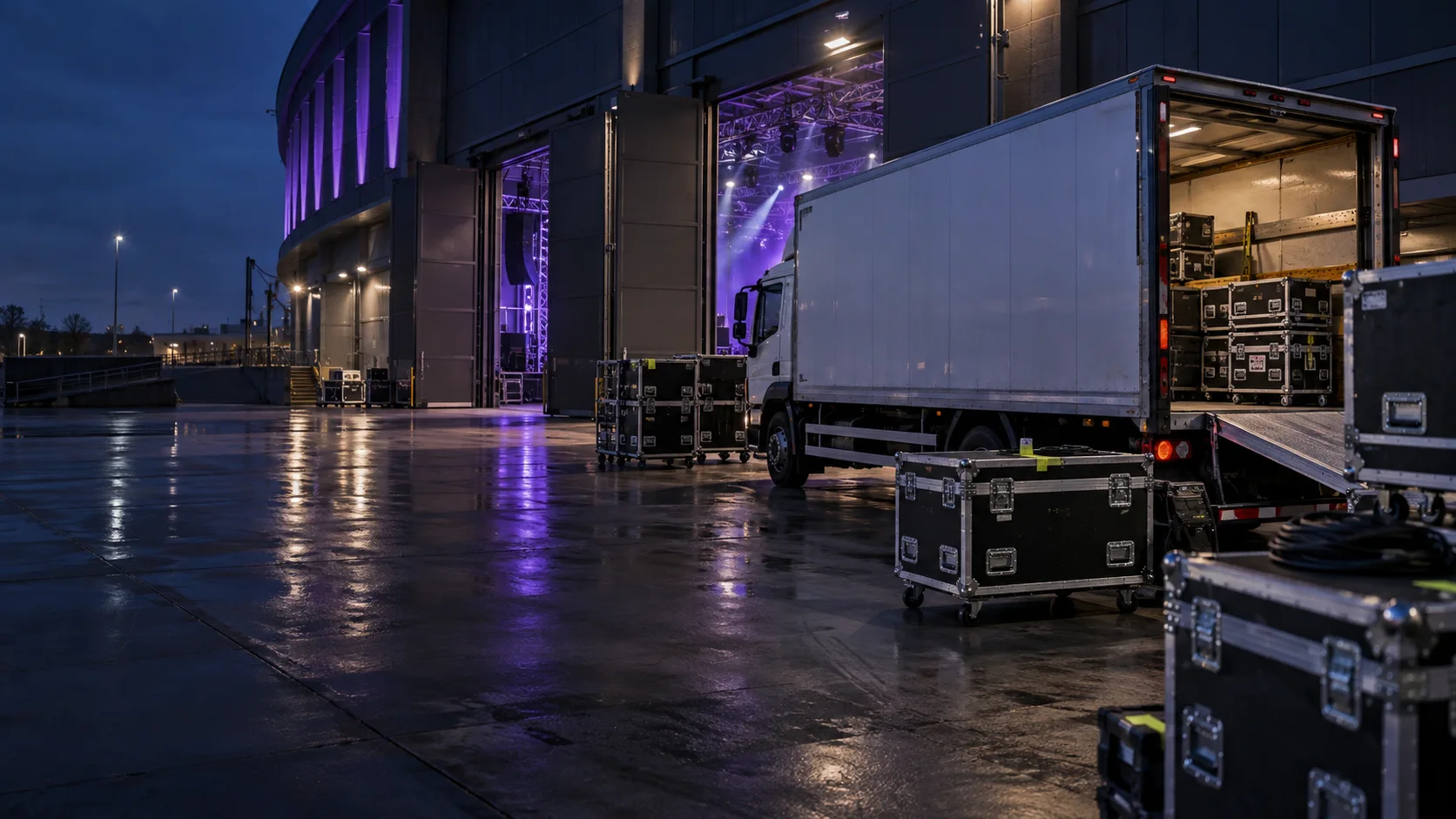
Exhibition and event transport
Choose the next unresolved decision. This guide moves from an initial brief through comparable quotations to confirmed handovers and destination details.
Capture cargo, packages and open points in one brief. Keep unknown dimensions explicitly marked as unknown.
Quotation for trade show and event transport: the details that count ↗Give both providers the same quantities, timing and scope. Mark differences before comparing prices.
Comparing event transport quotations fairly ↗Assign preparation, receipt and time-window confirmation to specific people.
Handover at the destination: who unloads, who builds? ↗Choose the actual collection and receiving locations. Define whether the job ends at a terminal or at the final address.
Countries & routes ↗Use the same enquiry basis for both quotations in each row. “Open” does not mean included. Select and copy the fields into your own document.
| Comparison point | Common enquiry basis | Quotation A | Quotation B |
|---|---|---|---|
| Outbound, return and onward legs with final addresses | Enter / confirm | Enter / confirm | Enter / confirm |
| Packages, packed dimensions and weight per direction | Enter / confirm | Enter / confirm | Enter / confirm |
| Readiness, receiving windows and deadlines | Enter / confirm | Enter / confirm | Enter / confirm |
| Handover point and movement within the site | Enter / confirm | Enter / confirm | Enter / confirm |
| Packaging, loading and unloading: who does what? | Enter / confirm | Enter / confirm | Enter / confirm |
| Waiting-time terms and additional tasks | Enter / confirm | Enter / confirm | Enter / confirm |
| Open assumptions, exclusions and approvals | Enter / confirm | Enter / confirm | Enter / confirm |
| Total price, currency and validity | Enter / confirm | Enter / confirm | Enter / confirm |
The opening of a trade show or event is not the delivery time. Exhibition centres and venues set their own build-up and delivery times, often by hall, gate or stand size. Record this window separately and state which handover point it applies to. We then plan the transport so that your material arrives at the right place within the permitted window.
Ready for collection means packed, labelled and available at the agreed handover point – not just finished in production. For punctual event transport, it should be clear exactly when that is the case. Keep this separate from print approval, a technical test or an internal project meeting, because hours or days often lie between these steps.
The postal address of an exhibition centre, hotel or event venue rarely leads straight to the delivery area. For the transport request, what matters is the gate, the loading bay, the access rules and the place where the goods are handed over. Add the specific entrance given and the organiser’s information – and whether entry, registration and handover point are in the same place or separate.
During an exhibition or stage build, not everything is needed at the same time: flooring and structure come first, then walls and technology, and finally set dressing, exhibits and consumables. Describe which material groups should be on site first and which can follow later. On that basis we check whether a phased delivery makes sense and how it can be organised.
Event schedules shift: the build-up is brought forward, a programme item is dropped, dismantling starts later. Not every change affects every transport detail. Name the specific change and distinguish between date, time window and handover location. That way we can quickly see what still applies from the existing plan and what has to be agreed again – and you keep the overview.
The packing list is the most important document in any event transport. It links the visible labels on crates, cases and bundles to the units actually prepared. Done well, store, driver and crew at the venue all use the same names – and every question can refer to a specific package rather than to “the tech” or “the stand material”.
Many event transports are planned before the stand or stage design is finished. That is not a problem: you can request with provisional quantities and discuss capacity and schedule early on. What matters is to mark estimates clearly and state which material groups are already fixed and which may still grow.
Between handover of material and the finished show come build-up, tech check and often a rehearsal. For transport planning, what counts is the time your build crew actually needs the goods – not the public opening. Describe this dependency clearly without copying your entire production plan into the request; a few marked times are often enough.
During build-up, empty crates, cases and protective packaging quickly disappear from view – at dismantling they are suddenly urgently needed. For a smooth return, it should be clear early on which containers will be needed again, where they stay during the event and who brings them back to the material in time.
Some packages are needed earlier in the build than others – the floor before the walls, the truss system before the lights, the tools before anything else. Mark such priorities directly on the packing list and state the reason. We can then agree loading order and unloading so that your team can start building without waiting.
Whoever runs the stand is not automatically responsible for receiving goods – and when the shipment arrives, the project lead is often still on a plane. So name a receiving contact with a specific role, phone number and handover location. Especially for agency and stage projects, it should be clear who accepts the packages and allocates them to the right team.
Hall name and stand number add to the exhibition centre address – but they do not replace a description of exactly where the handover takes place. Use the same spelling in the request, packing list and project briefing, for example “Hall 4.1, Stand B22”. If the stand allocation changes during planning, the change should be visible to everyone involved.
“Delivery” can mean many things: at the loading bay, at the hall door, right at the stand or on stage. For a suitable quotation it should be clear where the handover takes place and which tasks your own team takes on. Describe the location and condition of the units at handover and replace general terms such as “set-up” with specific tasks.
Registering at the venue and handing over your shipment are two different steps – often in different places. Many exhibition centres require a vehicle access permit, a booked time slot or registration in a logistics portal for delivery vehicles. Gather the organiser’s current information and state which references already exist for your project and who will obtain missing ones.
At delivery, your receiving team wants to know quickly whether everything has arrived. That works with a clear list distributed in advance that uses the same package IDs as the collection point. Name groups that serve a common purpose. The goods description in your request then becomes a practical checklist for reception at the stand, the stage or the conference room.
Build crew, stand staff and dismantling team are rarely the same people. To make sure nothing is lost, it should be clear who receives the shipment and how the information is passed on afterwards: where packages are, where empties are stored, what is to go back. A clean handover within your project ensures that the return works even when the build crew has long since left.
If the person receiving the goods changes, name, role and phone number should be updated together. What matters is whether the new contact receives the same material groups in the same place. Describe a change of responsibility specifically – a new phone number without context is of little help to the driver at the gate.
Between the service yard and the handover point there may be long corridors, goods lifts, ramps, steps or narrow doors – especially in hotels, historic venues or theatres. Describe the confirmed route and the conditions known to your site contact. What matters are openings and level changes that affect receiving the packed units.
A good photo often saves several questions. Images can show the shape, packing condition and allocation of a shipment – especially for unusual items such as stage elements, decorative objects or oversized exhibits. Choose shots of the units actually prepared and link them to the IDs on your packing list. Current images help more than stand photos from last year.
The number of packages often changes shortly before collection: accessories are repacked, cartons combined, a case added. Compare the actual shipment with the most recent list and report differences with specific IDs. The project team can then tell whether only the packaging or the goods themselves have changed.
A reliable quotation for trade show or event transport comes from a few but complete details: what is being transported, from where to where, when and under which handover conditions. Start with the actual transport units and the two handover points. Add time windows and known conditions at the venue – the quotation can then reflect more than the event name and a rough crate count.
A price comparison only means something if both quotations describe the same transport requirement. So check route, package scope, time windows, handover points and return trip side by side. Often a different assumption – such as outbound only instead of outbound and return – explains why two quotations for the same event look so different.
After a first quotation, the scope of material often changes: an exhibit is added, the stage gets bigger, printed matter is dropped. Compare the new shipment with the list the quotation was based on and name added or removed units. Quotation and actual transport then stay on the same basis – and there are no surprises at the end.
After the show comes the return transport – and it often looks different from the outbound trip. Samples were handed out, printed matter used up, packaging swapped, some items go to a different site. So describe the expected return quantity, the return destination and the requested collection period. The return can then be requested and priced as a job in its own right instead of simply mirroring the outbound trip.
Material from the store, printer, stand-build workshop and AV rental company may be destined for the same event – but ready at four different places. Give every actual collection point with the quantity prepared there. A total package count alone does not describe which routes and stops come together in the transport; for planning and quotation, that is exactly what matters.
Whether a transport needs a van, a truck with tail lift or an articulated lorry depends on packed dimensions – not on the size of the assembled exhibit. For a quotation request, describe the packed condition: external dimensions and weight per unit, and which parts only form a complete exhibit or stage element together.
Not every time in an event project is equally binding. The organiser’s delivery window is fixed; collection from your own store may be flexible. Mark which handovers are tied to fixed requirements and where your team has room to manoeuvre. This distinction makes the request more precise and sometimes opens up better solutions in scheduling and planning.
Registering at the gate, waiting for a free slot, material released only after a programme item: at the venue, time can pass between arrival and handover. If your team knows about such procedures, describe them in the request. The quotation can then state transparently how waiting time is handled – instead of it first appearing on the invoice.
Many event briefings contain wishes that go beyond route and load: help carrying items to the stand, short interim storage, taking empties along, delivery at a fixed time. List such wishes as separate points and describe the result you want. We can then clarify what we can offer and show it explicitly in the quotation.
Procurement and event project management need the same facts but look at them differently: procurement wants comparable quotations, project management a working schedule. A structured briefing combines both – shipment data, dates and requested scope in one document. All incoming quotations are then based on the same description, and questions reach the right person.
Good to know
When both cover the same goods, directions, dates and handover points, with responsibilities and open assumptions described consistently. Mark differences in packaging, handling, waiting-time terms and validity before comparing prices.
Request transport
Describe your cargo, route and preferred dates. Together we turn these details into the basis for an individual quotation.
Your details and files are transmitted in encrypted form via Cloudflare to the Zammad ticket system of HSNK s.r.o. and stored there as an enquiry.
Your entries remain when moving between steps. They are not saved when the page is reloaded.